Ask people what uncensored AI models are for and most will say role-play and explicit chat. We run an API that serves only uncensored models, and our router records how every request is made, never what it says. So we looked. Over one week in November 2026, 157 paying customers sent 150,292 requests to 84 models. Almost none of it was chat.
The short version: uncensored models are being used as the engine inside AI agents. Coding agents and other agents account for 65% of the money spent on text models. Chat, role-play and creative apps account for 1.5%.
How we measured it, what it can't tell you, and the aggregate data are at the end.
1. Most of the traffic comes from agents
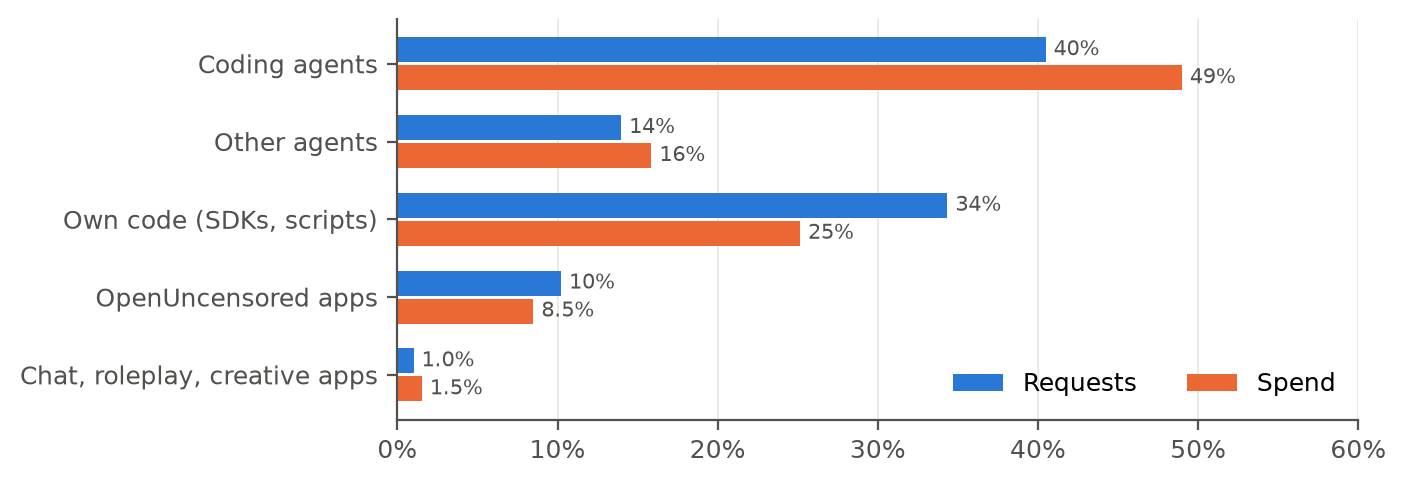
Every request names the app that sent it. Grouping them:
- Coding agents (OpenCode, Codex, Claude Code, GitHub Copilot Chat, Cursor and others): 40% of requests, 49% of spend. OpenCode alone, an open-source terminal coding agent used by 27 of our customers, carries more spend than every custom script combined.
- Other agents and automations: 16% of spend.
- Developers' own code through the OpenAI SDKs: 25% of spend, from 69 customers, the largest group by headcount.
- Chat, role-play and creative apps: 1.5% of spend.
Our own web chat was used by 45 customers but carries 0.6% of spend. People try uncensored models in a chat box. They spend money on them in agents.
2. Requests are enormous
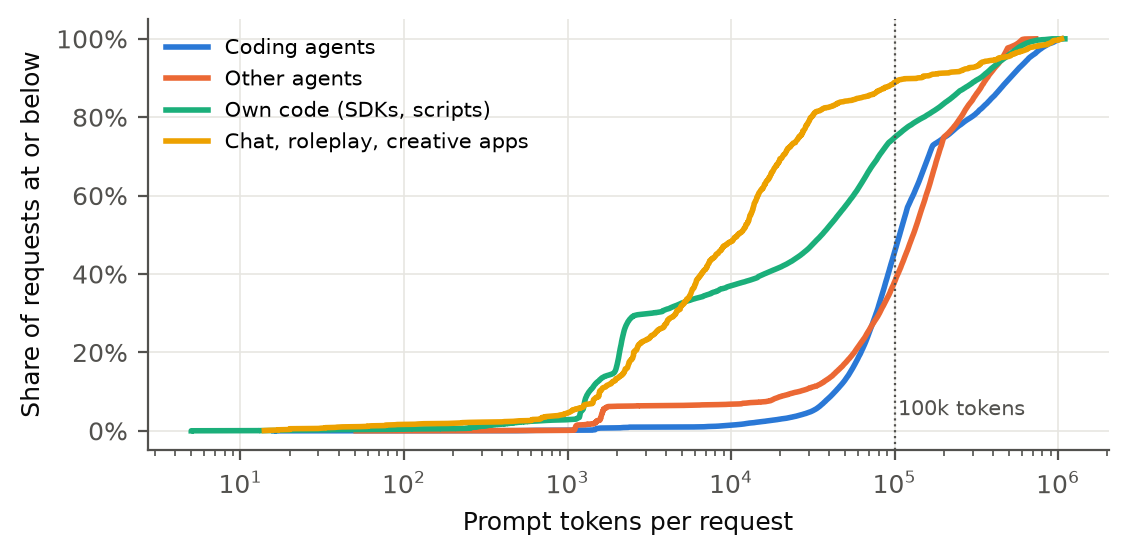
The typical request carries 86,612 tokens of prompt and gets back 229 tokens. 44% of requests send more than 100,000 tokens, and one in a hundred sends over 800,000. Prompts outweigh replies 292 to 1.
That is what an agent loop looks like. On every step the agent resends the whole session so far, including file contents and command output, and asks for a short next action. Codex sessions are the largest: their typical request is 276,569 tokens.
3. Most of the bill is re-reading context
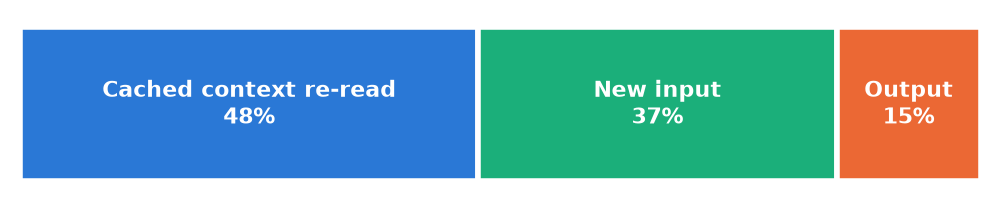
Because agents resend the same context, 96% of all prompt tokens are served from the provider's prompt cache, at a fraction of the normal price. Even so, re-reading cached context is the largest part of the bill (48%), new input is 37%, and the model's output only 15%. Without prompt caching, the same week would have cost 11 times more.
For anyone choosing a provider for agent work, the cached-token price matters more than the input and output prices on the front page. Between providers serving the same model, we see cached-token prices differ by a factor of five, which is why our router ranks providers by the cost of the request with its expected cache hits.
4. A few big models win
DeepSeek V4.1 Flash 1017 Uncensored, a 1M-token-context model with tool calling, took 53% of text spend. The top three models took 76%. By family, DeepSeek models took 68%, GLM 14% and Qwen 11%. The Llama- and Mistral-based fine-tunes that dominate uncensored-model discussion, including role-play favourites like Euryale, Magnum, Cydonia and MythoMax, together took under 0.2%.
The models that win are the ones an agent can use: big, long context, good at tool calls, and cheap to re-read. Image generation is a smaller but broad use: 1.4% of requests from 45 customers.
5. ChatGPT sends the buyers
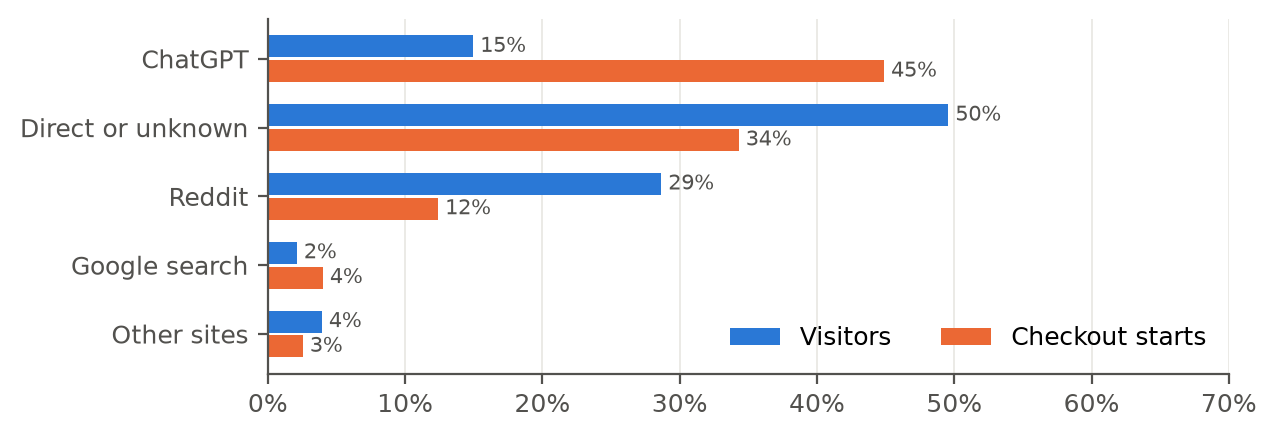
ChatGPT sent 15% of our website visitors but 45% of the people who started a checkout. Visitors from ChatGPT started a purchase 15.3% of the time, against 9.7% from Google, 3.5% for direct visits and 2.2% from Reddit. Reddit sent twice as many visitors as ChatGPT and less than a third as many checkouts. People who ask an AI assistant where to find an uncensored model arrive ready to use one.
6. Small, global payments
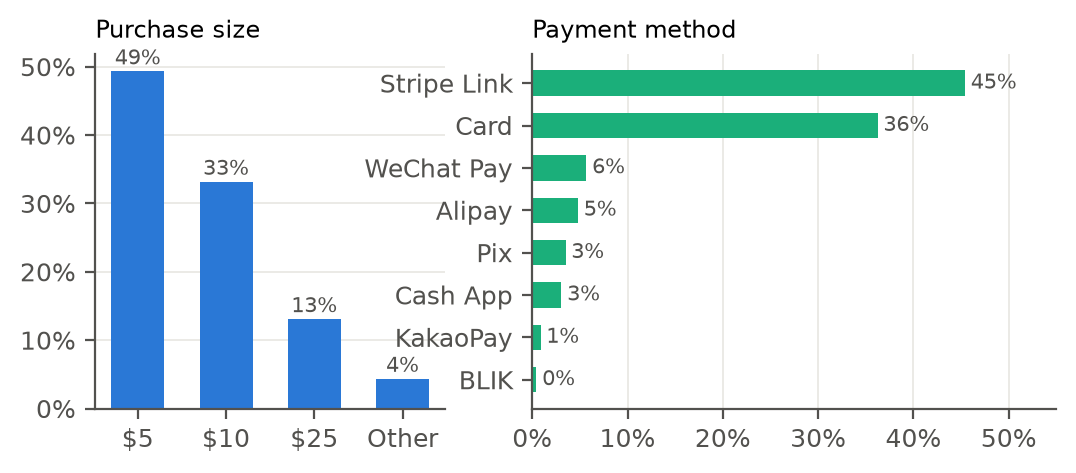
Half of all purchases are the $5 minimum and a third are $10. 18% are paid with a wallet other than a card or Stripe Link: WeChat Pay, Alipay, Pix, Cash App, KakaoPay or BLIK. 30% of buyers are in the US, followed by Germany, Brazil, France, Turkey, Japan and the UAE. 15% bought again within the week, and 7% of purchases came through our agent checkout API or the desktop app.
What this means
- Test uncensored models as agents. Refusal counts and short quizzes measure the 1.5% use case. The rest needs a model that stays stable over hundreds of steps at 100,000+ tokens of context. Our rankings already run agent tasks; this data says they matter more than anything else we measure.
- Price on the cache. For agent traffic the cached-token price decides the bill.
- Why agents? Our guess. We can't see what the agents were doing, because we never store prompts. Our guess is that mainstream models refuse often enough in ordinary agent work (security tooling, scraping, handling sensitive files) that developers swap the backend. That is the question we most want to answer next.
How we measured it, and what it can't tell you
- Data: request metadata from November 6 to 13, 2026 (time, app, model, provider, tokens, cache hits, cost, timing), website visit events, and credit purchases. Our router never stores prompts or replies, so none were read.
- Privacy: customer and visitor ids were replaced by random codes before analysis. We name an app or a country only when at least five customers are in it. Our privacy policy covers publishing aggregate statistics like these.
- Excluded: three accounts we use for our own testing.
- Limits: one service, one week, in our second week of paid operation. Our users find us through developer channels and AI assistants, which may over-represent agent users; role-play users may prefer subscription chat apps we don't see. Apps are identified by the name they send, and "own code" can be anything.
- Disclosure: we run the service studied.
Get the data
- Aggregate tables (CSV): usage-report-tables.zip: shares by app, category and model, prompt-size percentiles, spend by token type, daily activity, traffic sources and payment mix.
- Figures: free to reuse with a link to this page.
If you build agents and want an uncensored backend, the API is OpenAI compatible and needs no account: get a key, or point your agent at openuncensored.com/agents.md.